
ARCHITECTURE ENGINEERING


ARCHITECTURE ENGINEERING
Applications in a Variety of Scenarios
1.Commercial Building Facade Curtain Wall System
2. Public Venue Acoustic Engineering
3.Transportation Infrastructure Noise Reduction
4.Data Center & Equipment Room Enclosure
5.High-End Residential & Hotel Interior Decoration
6.Prefabricated Building Lightweight Wall Panels
Product Overview
Metal foam is an ultra-light porous metallic material with a density ranging from 0.15 to 3 g/cm³. It combines the structural strength of solid metals with the multi-functional porous characteristics of foams. For the construction sector, two main product forms are adopted: open-cell metal foam (for sound absorption & noise reduction, ventilation & air permeability, thermal insulation, and structural support) and metal foam sandwich panels (for curtain wall enclosures and decorative panels). These products serve five core construction scenarios: building curtain walls, interior decoration, acoustic engineering, fireproof enclosures, and lightweight structural design.
Six Core Functions of Metal Foam in Construction
Function 1: Sound Absorption & Noise Reduction
The interconnected porous structure of metal foam causes sound waves to refract and collide repeatedly upon entering the material, converting acoustic energy into thermal energy for dissipation. Its sound absorption coefficient can exceed 0.8 in the mid-to-low frequency range, with an average octave-band absorption coefficient above 0.4.
Applicable scenarios:
● Ceiling and wall sound-absorbing panels for theatres, concert halls and lecture halls
● Noise reduction partitions for open-plan offices and hotel lobbies
● Acoustic treatment for public areas of metro stations and airport terminals
● Noise barriers along highways and sound-absorbing liners for railway tunnels
Function 2: Thermal Insulation & Heat Preservation
Metal foam contains numerous stationary air chambers, delivering a thermal conductivity of only 0.268 W/(m·K), equivalent to the insulation performance of marble. When filled into exterior wall interlayers or curtain wall backboards, it significantly blocks heat exchange between indoor and outdoor spaces and cuts building heating and cooling energy consumption.
Applicable scenarios:
● Thermal insulation interlayers for exterior walls of commercial buildings
● Heat insulation backboards for curtain wall systems
● Reinforced enclosures for residential buildings in cold regions
● Heat insulation barriers for high-temperature zones in industrial plants
Function 3: Class A Fire Resistance & Flame Retardancy
Made of pure metal substrates, metal foam is non-combustible and releases no toxic flue gas, with a melting point of approximately 1500°C, complying with national Class A building fire protection standards. In high-rise buildings and public venues with strict fire control requirements, metal foam can replace traditional combustible thermal insulation boards and plastic sound-absorbing panels to eliminate fire hazards at the material source.
Applicable scenarios:
● Decorative panels for public areas in high-rise residential buildings and office towers
● Enclosures for fire escape routes in hospitals, schools and shopping malls
● Fire sealing for underground spaces and tunnels
● Partition wall panels for data center machine rooms
Function 4: Curtain Wall Decoration & Light and Shadow Effects
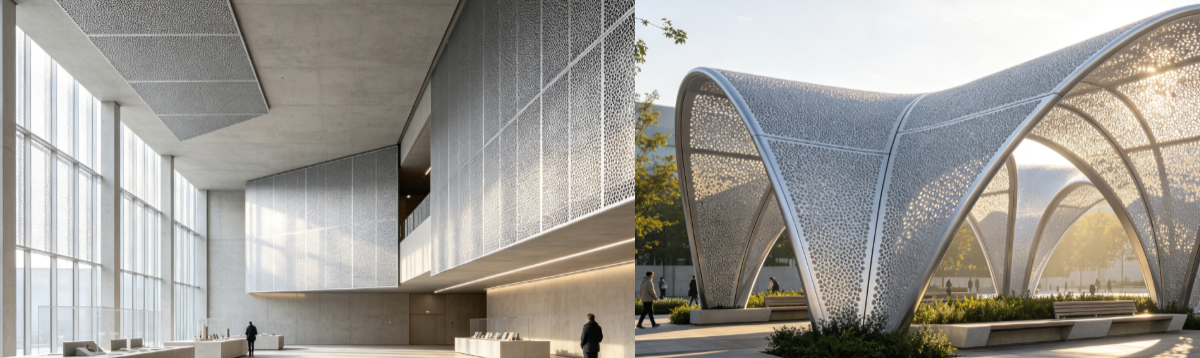
Metal foam panels retain the natural metallic luster of raw materials. Their surfaces can be treated via anodizing, powder coating, sandblasting or perforation to form diverse visual textures including honeycomb grains, rock cracks and shattered ice patterns. Large-aperture light-transmitting panels paired with backlighting create stunning light and shadow effects, delivering both functional and aesthetic value.
Applicable scenarios:
● Exterior curtain walls of commercial complexes
● Interior decorative walls for high-end hotels and brand flagship stores
● Art installation panels for cultural centers and exhibition halls
● Ceiling panels and luminous partitions
Function 5: Electromagnetic Shielding
Metal foam achieves outstanding electromagnetic shielding effectiveness covering the frequency band of 6–18 GHz. Its construction applications include:
● EMI shielding layers for walls of data centers and communication equipment rooms
● Electromagnetic isolation enclosures for MRI/CT equipment rooms in hospitals
● Shielding wall panels for weak current control rooms in smart buildings
● Electromagnetic safety barriers for military classified facilities
Function 6: Lightweight Structural Design & Seismic Energy Absorption
The density of foamed metal is only 59 times that of solid metal. It can absorb impact energy of over 2.5 MJ/m³ at 50% deformation. In building structures, it can be used as:
● Lightweight core materials for long-span ceiling sandwich panels
● Vibration-damping filling layers for cantilever structures
● Energy-absorbing buffer components for buildings in seismic zones
● Lightweight core materials for prefabricated building wall panels
Metal Foam Sandwich Panels – Integrated Solution for Building Curtain Walls
Metal foam sandwich panels feature a "skin-core-skin" sandwich structure, bonded by two outer metal face sheets (aluminum or steel plates) and an intermediate metal foam core. This is the most mature metal foam product form widely used in the construction industry.
Core Performance Advantages
● Ultra-high specific stiffness: Far superior bending stiffness than solid metal plates under identical weight
● Integrated multi-functionality: Single panel integrates decoration, thermal insulation, fire resistance, sound insulation and electromagnetic shielding
● Lightweight & rapid installation: Weight equals 1/30 to 1/5 of solid metal plates; compatible with dry-hanging assembly and modular construction
● Weather resistance & anti-corrosion: Non-hygroscopic, mould-proof and anti-aging, suitable for both indoor and outdoor use
● Full-life environmental friendliness: Can be manufactured with 20%–100% recycled materials and 100% recyclable upon end-of-life
Specification Range
● Panel thickness: 5–50 mm curtain wall panels; thicker panels can be achieved by bonding multiple layers together
● Standard dimensions: 500 × 1000 mm; bondable; customizable
● Surface finishes: powder coating, sandblasting, perforation, artistic textured treatment
● Installation methods: adhesive bonding, screw fastening with light steel keels, dry-hanging systems
Detailed Introduction to Six Major Construction Application Scenarios
Scenario 1: Curtain Wall Systems for Commercial Buildings
Metal foam sandwich panels serve as exterior enclosure panels, replacing the traditional three-layer system consisting of aluminum single plate + insulation layer + fireproof board. A single panel integrates decoration, thermal insulation and fire resistance. Its lightweight property reduces load on curtain wall keels and shortens construction periods. Class A fire performance satisfies fire codes for high-rise buildings, while metallic finishes with anodizing or custom coating deliver a premium modern appearance.
Scenario 2: Acoustic Engineering for Public Venues
For theatres, concert halls, lecture halls and other spaces with strict acoustic standards, open-cell metal foam sound-absorbing panels act as core ceiling and wall materials. With a mid-low frequency sound absorption coefficient above 0.8, they effectively eliminate echo and standing waves. Combined with perforation treatment and back cavity tuning, the sound absorption curve across all frequency bands can be precisely calibrated. Metallic materials are non-combustible, non-hygroscopic and anti-aging, boasting a far longer service life than traditional fabric sound-absorbing panels.
Scenario 3: Noise Reduction for Transportation Infrastructure
Open-cell metal foam panels are adopted as permanent acoustic barriers for highway noise walls, railway tunnel liners and public metro station areas. With an NRC (Noise Reduction Coefficient) ≥ 0.75, the material features excellent weather resistance and anti-corrosion performance with zero routine replacement or maintenance required. Its built-in insulation layer simultaneously blocks thermal radiation and noise generated by moving trains.
Scenario 4: Enclosure Systems for Data Centers & Equipment Rooms
Metal foam sandwich panels are used for partition walls and suspended ceilings in data centers. Class A fire resistance safeguards server equipment; structural insulation cuts air conditioning loads; electromagnetic shielding performance of 60–90 dB protects servers from electromagnetic interference. The lightweight design enables fast modular assembly to support flexible data center capacity expansion.
Scenario 5: Interior Decoration for High-End Residential Buildings & Hotels
Metal foam decorative panels are applied to lobby feature walls, elevator hall claddings and suspended ceilings. Metallic luster and porous textures create a sophisticated modern aesthetic. Large-aperture light-transmitting panels paired with LED backlighting deliver twinkling starlight visual effects. Being non-combustible with zero formaldehyde and zero VOC emissions, the material meets health standards for high-end residential living spaces.
Scenario 6: Lightweight Wall Panels for Prefabricated Buildings
Metal foam sandwich panels function as core materials for internal and external wall panels of prefabricated buildings. They feature ultra-light weight (1/10 the density of solid metal), high stiffness (1.5 times the bending specific stiffness of steel) and Class A fire resistance, serving as an alternative to traditional aerated concrete panels and rock wool sandwich panels. Modular dry-hanging installation boosts construction efficiency by over 300%.
If you would like to order custom metal foam or porous metal, please call Huayan Intelligent Technology at +8613661985902,Email: admin@hy-metalfoam.com


GET CUSTOMIZED
METAL FOAM SOLUTIONS
-
Add:No. 6-1, Fengshanzui Road, Longshan Town, Yongkang City, Zhejiang Province
-
M.T.:+86 13661985902
-
Fax:0571-88888888
-
Tel:0571-88888888
-
E-mail:admin@hy-metalfoam.com
Contact us
Customization Materials
